Showing posts with label maturity. Show all posts

Monday, November 22, 2010

Family Resemblance


Some day our digital photos
will look just as quaint!
 Last week I spent time with members of my extended family, some of whom I had not seen for a number of years. We were gathered to memorialize the life of an elderly aunt who died the previous weekend. Although we felt the loss, our being together again was like her parting gift to us. We laughed and hugged, shared pictures and memories, and ate and sang, all the while being aware of how much she herself would have enjoyed this family celebration!

I was struck by the family resemblance I see on the faces of my cousins, now that they mature. They actually look more like their fathers or uncles than they look like each other. And they tell me too, that now I look like my mother whose features are clearly seen in our other aunts. Indeed, we do look like the family we belong to!

I wonder if that is true of us as Christians? As we mature, do we look more like the family of God? Do our lives bear resemblance to our Elder Brother and to the Father Himself? He would be so pleased!
 
MaryMartha
 
Art from http://www.sxc.hu/

Monday, June 21, 2010

Not Moved


Deeply rooted plants can make it through the storms. One can see, in the Cascade Mountains of Washington, tall weathered-gray pines that have spiraled trunks. The winds blow there day after day, year after year, tossing and turning the branches, but these are old trees, deeply rooted, and the wind's force has finally twisted their trunks rather than tearing them from the soil as it might have done with more shallow trees. Can we, like those tough old tress, weather the storms?

The Psalmist declared several times, "I shall not be moved." What does mean? I won't be hurt or disappointed or troubled? I won't face difficulty or loss? No, if you are familiar with David's story, you know that all of these circumstances were a regular part of his life. The apostle Paul, too, said, "None of these things move me." He was referring to murderous plots against him, to his own humble servitude, and to a future that was uncertain except for the knowledge that it held imprisonment and tribulation! None of these things matter to me? No, none of these things will change my course. None will divert my attention from the truth that is established in me.

Can anything ever separate us from Christ’s love? Does it mean he no longer loves us if we have trouble or calamity, or are persecuted, or hungry, or destitute, or in danger, or threatened with death? . . . No, despite all these things, overwhelming victory is ours through Christ, who loved us.

And I am convinced that nothing can ever separate us from God’s love. Neither death nor life, neither angels nor demons, neither our fears for today nor our worries about tomorrow—not even the powers of hell can separate us from God’s love. No power in the sky above or in the earth below—indeed, nothing in all creation will ever be able to separate us from the love of God that is revealed in Christ Jesus our Lord. (Romans 8:35, 37-39)


I recall our singing "I Shall Not Be Moved" as a family when we were in the car together, going to church or traveling the long road to Grandma's house (30 miles, a long way back then!) It's a traditional American folk song, perhaps going back to the slavery camps.

I shall not be, I shall not be moved.
Just like a tree that's standing by the water,
I shall not be moved.

Then one of us would begin,
"Jesus is my Savior, I shall not be moved . . ." or "I'm on my way to heaven, I shall not be moved . . ."
and the others would all chime in. This continued until we mercifully reached our destination or we tired ourselves out and switched to something else.

That was many years ago, and now I do sometimes feel like one of those gnarly old trees that's been twisted by the winds that have blown on the mountain top! Perhaps you feel this way too, but better for us to be twisted (in this good sense of the word) and still firmly planted, than broken and toppled over!

We shall not be moved!
MaryMartha

Scripture quotation is taken from The Holy Bible, New Living Translation, copyright © 1996, 2004. Used by permission of Tyndale House Publishers, Inc., Wheaton, Illinois 60189. United States of America. All rights reserved.

Art from http://www.sxc.hu/

Tuesday, February 16, 2010

Under the Circumstances


We use the idiom frequently: "Under the circumstances, I had to leave," or "Under the circumstances, we were not able to attend" and so forth. We understand it to mean "in this situation" or "given these conditions": or "such being the case." But it is a strange way to express that, don't you think? Under the circumstances? As if something is on top of us, preventing action that we would otherwise take.

And that is what caught my attention: the idea of something being on top of us, perhaps even weighing us down. A spell of foul weather. The bus running late. The grocery store out of my brand of coffee. The toddler who can't go to daycare with the sniffles, or I don't feel so good myself. All of these things are "circumstances"—situations, conditions, cases that we have to deal with. And sometimes they get us down. We get under them.

"Rejoice in the Lord always," the Apostle Paul wrote, and for emphasis he added, "I will say it again: Rejoice! . . . Whatever is true, whatever is noble, whatever is right, whatever is pure, whatever is lovely, whatever is admirable—if anything is excellent or praiseworthy—think about such things." (Philippians 4:4, 8)

Yes, the weather is terrible, but it is going to clear tomorrow—or by next week, or whenever. Yes, the bus is late, but when it gets here, I'll get warm again—or cool, as the case may be. Yes, my favorite coffee isn't here, so I'll get this smaller can of Brand B to tide me over—or maybe I'll check at another store. Yes, the baby can't go to Wee Care, so Grandma or one of us will give her a lot of TLC today. Yes, I'm sick but I'm not going to make it harder than it has to be by complaining.

I think sometimes we are afraid to look on the positive, hopeful side of things because we are afraid of being accused of being a Pollyanna. If that seems like a problem, just smile and don't say anything about your reason for doing so! Refuse to be under the circumstances!

MaryMartha

Scripture taken from the Holy Bible, New International Version®. NIV®. Copyright©1973, 1978, 1984 by International Bible Society. Used by permission of Zondervan. All rights reserved.
Art from http://www.sxc.hu/

Tuesday, February 9, 2010

Mile-Pebbles

We call some of the outstanding events of our life "milestones." We were too young to comprehend the significance of some of the early ones, but our families celebrated for us when we took our first steps, when we started school, when we lost our first tooth. Later, in no special order, there were our first jobs, our driver's license, our first car, the first date, graduation from high school and perhaps from college. Marriage for some of us. Our first home. Parenthood maybe. A marked career achievement. A hard-won honor. Retirement. Life has a number of places where we stop and say, "Wow! Look at where I (or we) have been and what we've done!"

But life isn't only about extraordinary occasions. It's mostly about the "nitty-gritty" of day-to-day issues and tough decisions. Yesterday an advertisement in a magazine caught my attention. A financial company wants to help me reach all my milestones—and my mile-pebbles.

No matter where you are on your life-journey, there are still important goals at which to aim. Perhaps you have already arrived at many of the milestones you expected to reach in your lifetime, but don't stop there! Not every goal has to be so lofty that it takes a lifetime to achieve. There are many less-imposing but worthwhile things to do and to be. They don't all have to be momentous milestones.

Celebrate the mile-pebbles too!

MaryMartha

The ad is by Ameriprise Financial in the current issue of Time.
Art from http://www.sxc.hu/

Thursday, January 28, 2010

Give Me This Mountain

"Give me" is often a selfish request. Whether it's a child who has learned that "gimme some" gets him what he wants or the adult who is hoping for his/her gains to come with no personal effort, the expectation is basically self-centered. Even prayers are sometimes selfish, not going beyond "Lord, give me this," and "O God, I want that."

But "give me" can also be a very mature and self-sacrificing request. Caleb's story is told in the Old Testament. The people of Judah came to Joshua, and Caleb spoke to him. "You'll remember what God said to Moses concerning you and me back when he sent us into Canaan to spy out the land. We brought back an honest and accurate report. The companions who went with us discouraged the people, but we stuck to our story because we trusted God. That was the day that Moses solemnly promised me, 'The land on which your feet have walked will be your inheritance, you and your children's, forever. Yes, you have lived totally for God.' Now look at me: God has kept me alive, as He promised. I was forty years old back then, and it is now forty-five years since God spoke this word, years in which Israel wandered in the wilderness. And here I am today, eighty-five years old! I'm as strong as I was the day Moses sent me out. I'm as good as ever in battle, whether coming or going. So give me this mountain [the hill country] that God promised me. You yourself heard the report, that a fearsome tribe of giants was there with their great fortressed cities. But If God goes with me, I will drive them out, just as God said." (from Joshua 14:6-12)

Caleb, even at eighty-five, was not expecting something for nothing. He was ready for war, ready to take on the hostile people in the land, ready to take the walled cities there, no matter what it cost. He was saying, "Just let me at it!"

Do we, when we pray, expect God simply to "give" us what we want? In His mercy, He often does, but sometimes, just as we may deny the whining child's demand, He chooses another way to answer. Sometimes He doesn't lay the desired thing in our hands until we've done battle with the "giant" that is withholding it. Sometimes we cannot just walk in and take over the "walled cities" but have to strategize and to marshal all the forces at our disposal before the answer comes. But like Caleb we can say, "If God goes with me, I will get what He intends to be mine. I am not afraid. I can take this mountain!"

MaryMartha

Art from http:www.sxc.hu/

Thursday, January 7, 2010

Things Mama Taught Me: "You'll Spoil Your Appetite"

This is what my mother warned when we wanted a snack too close to supper time or wanted sweets instead of more nourishing fare. I never lacked appetite, so I don't know that her admonition was necessary; nevertheless, she had a good point. It's very easy to leave out foods that are important for the body's maintenance and growth by substituting what we call "junk food" for its lack of those valuable nutrients.

I think it's possible to dull intellectual, cultural, and spiritual appetites also. If the brain is never challenged to process things that are beyond immediate recognition, where will new ideas come from? If appreciation for the arts is dumbed down to awe of dazzling technological displays, what will feed our souls? If beauty is only superficial and goodwill is a commercial product, how will we recognize truth? If everything we read or watch is "mind candy," how will we grow in the ability to fulfill our responsibilities? If we are used just to nodding to God once a week, how can we know His voice on the day He wants to speak to us?

"For He has satisfied the thirsty soul, and the hungry soul He has filled with what is good." (Psalm 107:9) Let's not spoil our appetites!

MaryMartha


Scripture is from the New American Standard Bible, used by permission of The Lockman Foundation, http://www.lockman.org/


Art from http://sxc.hu/

Tuesday, November 3, 2009

The Seed Is the Word of God

We read in Mark's gospel a story that Jesus told:

"Listen. What do you make of this? A farmer planted seed. As he scattered the seed, some of it fell on the road and birds ate it. Some fell in the gravel; it sprouted quickly but didn't put down roots, so when the sun came up it withered just as quickly. Some fell in the weeds; as it came up, it was strangled among the weeds and nothing came of it. Some fell on good earth and came up with a flourish, producing a harvest exceeding his wildest dreams." (Mark 4:3-8 MSG)
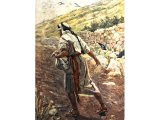
When they were off by themselves, those who were close to Jesus asked Him about the story. He explained that the seed is the Word of God, intended for fruitful planting in human hearts, but that not all of it produced a good harvest. If we too could ask our Lord Who sows the seed what His stories mean, our question might be, "As these still the hearts of people today, and the different ways that they receive truth?"

What would the Lord of Harvest say in reply?

Perhaps He would agree, "Yes, these are the hearts of people and their responses. But not always other people and not always different hearts. It is much more personal than that! I want to talk with you about your heart, and about your response which differs from time to time."

"Sometimes," He might say to us, "I sow the seed, my Word, upon your heart and it is like the seed which fell upon the travel-worn path and was devoured by the birds. You see, you hesitate at times to ask Me what I think about certain things. You may even draw back a bit from getting too close to Me, because you vaguely know that the truth I am casting your way is very close and personal. The enemy is always there when I talk to you, and if you do not quickly receive what I have to say, he snatches it away just like the birds that came and ate the seed the farmer planted. No, this seed falling by the wayside is not the harsh rejection of a calloused world. It can be your heart if you are not really ready to receive what I am saying to you."

And what about the stony ground?

"The stony ground too," the Lord might explain, "is sometimes what you offer me. Hearing my Word, you immediately receive it with gladness. I rejoice to see your eagerness to please Me, your willingness to do anything I ask. But you have no root! You endure only for a time, and then, when temptation comes or hardship arises from your obedience or others question it, you are offended. You welcome the truth in its seed state, but then you resist its growth and development! The maturing of truth is demanding, and sometimes I see with disappointment that you are not quite willing for that much stretching. Yes, the stony ground can be your heart.

And the ground full of weeds?

The Lord might have to say, "Some of My Word falls where thistles grow. When I see truth flourishing in your life, I am glad! But then I see other things crowding in. You involve yourself in too many things to do. You get too busy. The desire for communion with Me is dulled by other interests. Sometimes mere temporal things deceive you, and what should be only a part of your concern becomes disproportionately large. The patch of weeds is not the wandering prodigal with no use for God. It can be your heart, choked off from Me and unfruitful because it is bound by all the things that are not captured by My love."

Of course, wouldn't each of us respond, "Lord, I want my heart to be good, productive ground!"

Perhaps then the Lord's reply would be, "To be good ground, do this:

-- Hear the Word I give you. Do not let yourself be closed so that what I say is taken away from you; then your heart will not be like the hardened ground.

-- Receive My Word. Take it to yourself without reservation, and obey Me with all your heart continually. Do not fear it, but purposely nourish it; then your heart will not be as the stony gourd.

-- Guard my Word jealously, for many things will seek to crowd and push against it. Maintain a oneness of purpose. Then your heart will not be as the thorny ground.

"Let your heart by listening and receptive and obedient! Then there will be fruit, for where I find such ground, I grow a huge harvest, exceeding your wildest dreams!"


MaryMartha

Scripture taken from The Message. Copyright © 2003 by Eugene H. Peterson. Used by permission of NavPress Publishing Group.

(Edit 11/12/09: I replaced the two clips previously shown on this page.)

Art from http://www.biblepicturegallery.com/free/ and http://www.sxc.hu/

Tuesday, October 13, 2009

Continual Coverage

A year or so ago, I changed the type of insurance I have under a small life policy I hold. It was set to finish out its term at the certain age I was fast approaching, and then my coverage would end.

But let me tell you about my continual coverage! It's not a policy exactly, but a promise. "Listen to me, descendants of Jacob, all you who remain in Israel. [I've been adopted into that family, so it means me too.] I have cared for you since you were born. Yes, I carried you before you were born. I will be your God throughout your lifetime—until your hair is white with age. [I'm getting there!] I made you, and I will care for you. I will carry you along and save you." (Isaiah 46:3, 4 NLT)

The premiums in this plan are not going to change every few years as I age. The term is not going to come to an end. I don't even have "deductibles"; as a matter of fact, I am getting regular "dividends"!

What security!

MaryMartha

Scripture quotation is taken from The Holy Bible, New Living Translation, copyright © 1996, 2004. Used by permission of Tyndale House Publishers, Inc., Wheaton, Illinois 60189. United States of America. All rights reserved.

Saturday, September 19, 2009

A New Point of View

"Therefore if any man be in Christ, he is a new creature: old things are passed away; behold, all things are become new." (KJV) I spoke with a fellow Christian who told me, "I thought being a new creature meant my old habits and hang-ups were gone, and I wouldn't have to deal with them any more." If only that were true, how much easier life would be!

There is no denying that many people experiencing Christ's salvation have a radical change in their attitudes, appetites, and ambitions. But there is no guarantee that well-established behaviors are going to suddenly vanish. The Apostle Paul wrote, "I discipline my body [which is, after all, the point at which a great deal of failure begins] and bring it into subjection, lest, when I have preached to others, I myself should become disqualified." (I Corinthians 9:27 NKJV) Forgiveness is freely offered; a right relationship with God is the point His plan. But Paul found living righteously was not automatic.

"New creation" means, most of all, that the once-dead spiritual being has been brought to life. One of the evidences of this is in the mind. "We have stopped evaluating others from a human point of view. At one time we thought of Christ merely from a human point of view. How differently we know him now! This means that anyone who belongs to Christ has become a new person. The old life is gone; a new life has begun!" (II Corinthians 5:16, 17 NLT) At salvation, the new life has only begun; that is why we call it "the second birth." We begin then to live with more than just the human point of view, and to become mature in Christ, this new point of view must continue to expand throughout our whole faith journey.

God transforms us into new persons by changing the way we think. "So here's what I want you to do, God helping you: Take your everyday, ordinary life—your sleeping, eating, going-to-work, and walking-around life—and place it before God as an offering. Embracing what God does for you is the best thing you can do for him. Don't become so well-adjusted to your culture that you fit into it without even thinking. Instead, fix your attention on God. You'll be changed from the inside out. Readily recognize what he wants from you, and quickly respond to it. Unlike the culture around you, always dragging you down to its level of immaturity, God brings the best out of you, develops well-formed maturity in you." (Romans 12:1, 2 MSG)

MaryMartha

Scripture marked NKJV taken from the New King James Version. Copyright © 1982 by Thomas Nelson, Inc. Used by permission. All rights reserved. Scripture quotation marked NLT is taken from The Holy Bible, New Living Translation, copyright © 1996, 2004. Used by permission of Tyndale House Publishers, Inc., Wheaton, Illinois 60189. United States of America. All rights reserved. Scripture marked MSG is taken from The Message. Copyright © 2003 by Eugene H. Peterson. Used by permission of NavPress Publishing Group.

Friday, August 21, 2009

Not How It Used to Be

Nearly four hundred years after King Solomon completed the construction of the glorious Temple of God, it was destroyed by the Babylonians (586 BC). The invading army carried most of the citizens away, leaving only the poorest to care for the land. Eventually, some of the exiled were permitted to return, and with the support of the Persian ruler Cyrus and later Darius, the Temple was rebuilt (515 BC). The dimensions of the Second Temple were likely the same as that of the first, perhaps even on the repaired foundations of the first, but there was no way to reproduce the splendor. Both David and Solomon had opened their vast treasuries for the building and extravagant furnishing of God's house. Even with the aid of sympathetic foreigners, the present means of people in this desolate country were small compared to the immense resources of the former kings during prosperous circumstances.

"When the builders completed the foundation of the Lord’s Temple, the priests put on their robes and took their places to blow their trumpets. And the Levites, descendants of Asaph, clashed their cymbals to praise the Lord, just as King David had prescribed. With praise and thanks, they sang this song to the Lord: 'He is so good! His faithful love for Israel endures forever!' Then all the people gave a great shout, praising the Lord because the foundation of the Lord’s Temple had been laid. But many of the older priests, Levites, and other leaders who had seen the first Temple wept aloud when they saw the new Temple’s foundation. The others, however, were shouting for joy." (Ezra 3:10-12 NLT)

Those who knew the sadness of having no temple at all were overjoyed when they saw the foundation of the new one laid. To them, this was like food to a starving person. But for those who could remember the grandeur of the first temple, this new one would surely be far inferior. There was no likelihood at all of its being so richly decorated with precious materials. They wept aloud, their cries mingling with the cheers around them. Some translations say these were "ancient men," seventy or eight years old (uh oh!) They lamented, "This is not how it used to be."

I cannot help but think of this story when I hear some of my fellow church-goers speak slightingly of contemporary worship forms and church direction. Rather than bewail the loss of how things used to be, we must accept that many of those around us do not share the same memories. They, like the spiritually starved younger generation of Israelites, are overjoyed at the prospect and reality of worshipping in the presence of God together. We "ancient" folks are grown-ups now; we can feed ourselves, if need be. If you miss the old hymns, find a hymn book and sing yourself into grace! If you miss old-fashioned "cottage" prayer meetings, get some folks together! If you miss lively revival services, look around; they may not be in tents any more, but they still do exist in many places!

This is not how it used to be? Of course not. Nothing is. I'm with the Apostle Paul who declared, "So how am I to respond? I've decided that I really don't care about their motives, whether mixed, bad, or indifferent. Every time one of them opens his mouth, Christ is proclaimed, so I just cheer them on!" (Philippians 1:17 MSG)

MaryMartha

Scripture quotation marked NLT is taken from The Holy Bible, New Living Translation, copyright © 1996, 2004. Used by permission of Tyndale House Publishers, Inc., Wheaton, Illinois 60189. United States of America. All rights reserved. Scripture marked MSG is taken from The Message. Copyright © 2003 by Eugene H. Peterson. Used by permission of NavPress Publishing Group.

Monday, August 3, 2009

Floaters

My eyes are aging. Well, to be honest, the rest of me is also, but I am noticing the eyes. In the past, I've occasionally had "floaters," those fiber-like things that floated in my vision; after awhile, they always went away. But recently, I had a sudden accumulation of clumps and strings along with flashes of light. Naturally, I consulted my optometrist. He examined my eye with great care and found there was no imminent danger of a retinal tear. These symptoms are very common as the result of age-related changes in the eyes, he explained, and told me I could expect improvement in a few days or weeks. The floaters would wash down out of my direct line of sight or I would get used to seeing past them.

If I focus on what is right up in my face, I see spots and strings and a hazy net-like obstruction. A little further out, I see lines in the lenses of my glasses, and also the frames. I can see the end of my nose too. But when I focus on these, I can't see anything else very well. I know there is a computer screen out there but I cannot read it, and there is a lamp lighting the desk but I would not be able to describe it. Why? Because I have chosen to focus on something very near to me, excluding other things. If I want to see clearly something that is past my own nose, I will have to look past the tiny things that would interfere.

What a parable of spiritual vision! I don't even need to explain it.

MaryMartha

Thursday, June 25, 2009

Holy, Holier, Holiest


How would a school get the reputation of being "America's Holiest University"? I'm reading a book written by a journalist who attended there, and that's what he called it. There were rules: no drinking or smoking, no cursing, no dancing, no R-rated movies, and so on. While many young people thrived under that careful discipline, does observing rules really create holiness in a university—or, for that matter, in a Christian?

In the eighteenth century, John Wesley and his brother Charles were leaders of a group of young men at Oxford University, derisively called "The Holy Club" by other students. They met frequently for prayer, study and discussion, and to question one another about their Christian duties and their motives for performing them. Yet even the methodical practice of "holy living" did not produce the genuine state in John; it was not until almost ten years later, on May 24, 1738, that John experienced conversion while listening to a reading of Martin Luther's preface to the Epistle to the Romans.

In the Old Testament, people and things were declared holy because of their relationship to a holy God. They were devoted to Him or dedicated to Him, and God desired them to demonstrate that relationship in practical ways. The New Testament understanding of holiness differs only in the fact that Jesus came to show how it is done perfectly. Without flaw or failure, He exemplified a holy, rightly-related-to-God character. All His conduct was that of a person separated from sin and consecrated to God. The Apostle Paul makes our own responsibility clear: We are to avoid relationships that are forged in darkness rather than light; we must refuse to be driven by values that are incompatible with our commitment to God. Then, "'I will receive you. I will be a Father to you, and you will be my sons and daughters,' says the Lord Almighty. Since we have these promises, dear friends, let us purify ourselves from everything that contaminates body and spirit, perfecting holiness out of reverence for God." (II Corinthians 6:17-7:1)

What was perfect in Jesus is for us a lifelong exercise in love. "May the Lord make your love increase and overflow for each other and for everyone else, just as ours does for you. May he strengthen your hearts so that you will be blameless and holy in the presence of our God and Father when our Lord Jesus comes with all his holy ones." (I Thessalonians 3:12, 13)

So it turns out "doing holy," even with the best intentions, is not the same at all as being holy.

MaryMartha

Scripture taken from the Holy Bible, New International Version®. NIV®. Copyright©1973, 1978, 1984 by International Bible Society. Used by permission of Zondervan. All rights reserved.

Wednesday, June 24, 2009

Influencers in My Life

I have known Faith since I was a child. She was well-accepted in our community, and had a special place in our home as she helped my busy parents in the rearing of six children. She was instrumental in my school life too, where she encouraged me to be responsible and kind. She helped me memorize Scripture verses for vacation Bible School, and I learned to rely on her for assurance in spiritual matters. She sometimes smoothed the pathway of relationships with my siblings, but she also chided me when I was in the wrong! She has lived up to her name as a faithful friend throughout my entire life.

And Will? He was never not a part of my life! I didn't really get to know him until I was several years old, perhaps two or so, but he was there from the beginning. Although good-hearted, he sometimes got me into trouble by devising mischief for us to perpetrate, and those are the times Faith got after me! He probably had a more substantial effect on my life than anyone realized—good, for the most part. When I was in my teens, he was one of the main reasons for my determined efforts to excel at everything I attempted. He may have pushed a little too hard sometimes, but without him, I might not have persevered. I am grateful for his steadfastness.

Faith and Will wed about the time I entered college. That was a surprise to me because I had often noted their dissimilarities. I watched their lives over several decades, however, and saw how harmoniously the two worked together. I learned a great deal through their combined influence. One of the most important things they did was to encourage me to become closer to Grace, their mutual friend. Faith had introduced me years ago, but I did little to nurture the relationship and Grace is not one to be pushy. Consequently, I did not really know Grace very well until I was into my middle adulthood. Her loving attitude and gentleness have helped re-shape some of the rough places in my life.

My FAITH has found a resting place,
Not in device or creed;
I trust the ever living One,
His wounds for me shall plead.
Refrain:
I need no other argument,

I need no other plea,
It is enough that Jesus died,
And that He died for me. --Li­die H. Ed­munds, 1891

I can hear my Savior calling,
“Take thy cross and follow, follow Me.”
Refrain:
Where He leads me I WILL follow,
Where He leads me I WILL follow;
I’ll go with Him, with Him, all the way.—Ernest W. Blandly, 1890

Thro’ many dangers, toils and snares,
I have already come;
’Tis GRACE has brought me safe thus far,
And GRACE will lead me home.

The Lord has promis’d good to me,

His word my hope secures;
He will my shield and portion be,
As long as life endures. –John Newton, 1773 (?)

MaryMartha

Tuesday, June 16, 2009

Practice Makes Perfect . . . Sense

"Practice makes perfect," my teachers used to say. They wanted me to make, over and over again on my lined tablet, the ovals and strokes of the Palmer Method of Penmanship. I know I was very young; is it possible I learned cursive writing before or at the same time as manuscript? I understand that the inventor of the method recommended that it be taught exclusively, no printing first, so we dutifully practiced. My handwriting is legible— not perfect, but quite legible—and that came from that early practice

Ignace Jan Paderewski, one of the best-known musicians of his time (early twentieth century) as well as an influential Polish statesman, practiced his piano music endlessly. It could be argued that his performances were already "perfect," so why practice further? But he said, "If I miss one day of practice, I notice it. If I miss two days, the critics notice it. If I miss three days, the audience notices it."

Doctors and other medical professionals and attorneys may have spent a lifetime in their profession, and what they do is still called "practicing." There are bad jokes, of course, about why their work is a "practice," but in this instance, the word is not to be confused with rehearsing so as to acquire a competency. It is the practical application of the theories and skills presented in their training; the professionals are putting into "practice" their knowledge.

I wonder why we hear of "practicing Buddhists" and "practicing Jews" and other kinds of "practicing" believers, but we may never have even thought of the term, "a practicing Christian"? What would keep us from "practicing"? Have we decided it's just not possible to be perfect? Is it too hard to keep at it every day? Have we not learned anything that we could put into practice?

Because organized religions have certain customs and observances associated with them, the followers who adhere to these actions are said to be "practicing" their faith. Christians profess to be following Christ, in personal relationship with Him. Wouldn't practicing Christians be actively doing just that? Maybe not perfectly, but legibly. Every day, too, because otherwise our audience will be able to tell. And applying what we've learned in our heads to the action of heart and hands.

Practice makes perfect . . . sense.

MaryMartha

Saturday, June 6, 2009

Slightly Imperfect

Yesterday I was browsing through the catalog of an online store and came across their "Slightly Imperfect Store." What a great find! There were items for slightly imperfect Christians, slightly imperfect academics, slightly imperfect children (available for selection by age group), and slightly imperfect parents. At last, just what we need for the world we live in!

Just kidding! The sales were actually for "slightly imperfect" Christian books and scholarly tomes, "slightly imperfect" children's resources, and "slightly imperfect" parenting and home life guides. "Slightly Imperfect" caught my eye first because it is so true! We would like to think that there is such a thing as a perfect Christian or perfect parents with perfect kids. There isn't, but that is no reason to give up!

Our understanding of "perfect" is just not perfect! The call to perfection in Scripture is not to life with no mistakes or failures or "bad calls." It is the expectation that we will seek to be complete, thoroughly prepared, full of integrity, mature. This requires a process of growth, sometimes painfully achieved! "And because of his glory and excellence, he has given us great and precious promises. These are the promises that enable you to share his divine nature and escape the world’s corruption caused by human desires. In view of all this, make every effort to respond to God’s promises. Supplement your faith with a generous provision of moral excellence, and moral excellence with knowledge, and knowledge with self-control, and self-control with patient endurance, and patient endurance with godliness, and godliness with brotherly affection, and brotherly affection with love for everyone. The more you grow like this, the more productive and useful you will be in your knowledge of our Lord Jesus Christ. (II Peter 1:4-8 NLT)

"I ain't what I oughta be, and I ain't what I'm gonna be, but thank God, I ain't what I used to be!" With gratitude for having come a long way already, let's acknowledge that we're still slightly imperfect and like Paul, "press toward the mark for the prize of the high calling of God in Christ Jesus. (Philippians 3:14 KJV)

MaryMartha

Scripture quotation marked NLT is taken from The Holy Bible, New Living Translation, copyright © 1996, 2004. Used by permission of Tyndale House Publishers, Inc., Wheaton, Illinois 60189. United States of America. All rights reserved. Scripture marked KJV is from the King James Version.

Monday, June 1, 2009

Things Mama Taught Me: "Two Wrongs Don't Make a Right"

In the grammar of our language, two negatives used in a sentence result in a positive statement. "I am not unhappy," means that I am happy to some extent or at least neutral. "I don't like for there to be no answer," means that I do want an answer. In mathematics, too, multiplying two negative numbers gives a positive number. There are times, though, that this rule does not hold true, for my mother insisted that getting even for a wrong (a "negative" occurrence) by repaying with another wrong did not make for a happy, positive result.

The Lord says this, "Let justice roll on like a river, righteousness like a never-failing stream!" (Amos 5:24 NIV) Made in His likeness, we too want justice. We detest corruption, we want the rules to be fair, we expect wrongdoing to be dealt with. So often, like the children we once were, we want to see to it ourselves that wrongs are made right. And too often, we try to make things right by perpetrating another wrong. Instead, the Scripture tells us, "Don't hit back; discover beauty in everyone. If you've got it in you, get along with everybody. Don't insist on getting even; that's not for you to do. 'I'll do the judging,' says God. 'I'll take care of it.' Our Scriptures tell us that if you see your enemy hungry, go buy that person lunch, or if he's thirsty, get him a drink. Your generosity will surprise him with goodness. Don't let evil get the best of you; get the best of evil by doing good." (Romans 12:17-21 MSG)

I’m not sure there is such a thing as justice brought about by humans, since it is clearly an attribute of God. We all want it, but we sometimes do poorly at achieving it for our society. I am called upon as a child of God to live justly myself: "He has showed you, O man, what is good. And what does the LORD require of you? To act justly and to love mercy and to walk humbly with your God. (Micah 6:8 NIV) But I will not be able to fix my world by becoming the judge who can determine what is just and right, and the jury who will decide if others have kept the rules or not, and the enforcer who will mete out appropriate rewards and penalties. My "rules" just won't work for everyone, everywhere, all the time. Nor will responding with actions motivated by anger, hatred, or fear toward those who are unjust resolve the issues.

"Two wrongs don't make a right." Act justly. Love mercy. Walk humbly with God.

MaryMartha

Scripture quotations marked NIV are taken from the Holy Bible, New International Version®. NIV®. Copyright©1973, 1978, 1984 by International Bible Society. Used by permission of Zondervan. All rights reserved. Scripture marked MSG is taken from The Message. Copyright © 2003 by Eugene H. Peterson. Used by permission of NavPress Publishing Group.

You may be interested in reading another entry, "Revenge Doesn't Work."
Click here.

Friday, May 29, 2009

Another Birthday

I'm not old—yet—but the new calendar every year tells me that I'm getting there. Here is my thought for today and the year that follows:

Some people have a subtle prejudice against those who are aging, even their very own selves! God, however, is no respecter of persons, not giving consideration to those characteristics that are only temporary and changing. In fact, His Word speaks strong words of encouragement to those who have added some years of experience to their faith.

"O God, you have taught me from my earliest childhood, and I constantly tell others about the wonderful things you do. Now that I am old and gray, do not abandon me, O God. Let me proclaim your power to this new generation, your mighty miracles to all who come after me. (Psalm 71:17, 18)

“Listen to me, descendants of Jacob, all you who remain in Israel. [God is speaking to us, as we are adoptees in this family.] I have cared for you since you were born. Yes, I carried you before you were born. I will be your God throughout your lifetime—until your hair is white with age. I made you, and I will care for you. I will carry you along and save you. (Isaiah 46:3, 4)

"The godly will flourish like palm trees and grow strong like the cedars of Lebanon. For they are transplanted to the Lord’s own house. They flourish in the courts of our God. Even in old age they will still produce fruit; they will remain vital and green. They will declare, “The Lord is just! He is my rock! There is no evil in him!” (Psalm 92:12-15)

In the Old Testament history, we are told of several people who lived to "a good old age." The accounts say that they were "full of days," or "full of years"; life was complete for them. None of us can say exactly what "full of years" will mean for us—a great many years for some and fewer for others—but however many it is, God will make it complete for us. I especially like the description of Abraham who died happy at a ripe old age, having lived a long and satisfying life. Can another birthday be such a bad thing to happen to me?

MaryMartha

Scripture quotations taken from The Holy Bible, New Living Translation, copyright © 1996, 2004. Used by permission of Tyndale House Publishers, Inc., Wheaton, Illinois 60189. United States of America. All rights reserved.

Saturday, May 16, 2009

Believing and Becoming

A charming four-year-old of my acquaintance recently told her mother, "Mommy, when I grow up, I want to be a black man."

"Honey," the mother replied, "you're a little girl, and little girls grow up to be ladies. When you grow up, you'll be a lady, not a man."

"Oh. Well, then I want to be a black lady."

Mother gently explained to her fair-skinned child, "Honey, when you grow up, your skin will be pretty much just like it is now. You can't be a black lady."

"Oh." The child paused. "Well, then I'll just be an elephant!"

We are told that "if you can imagine it, you can achieve it." Does merely imagining something guarantee that it's within the realm of possibility? Obviously, the answer is sometimes no. But it is true, that if we are in fact going to become something, we must first believe it. By the time she is, say, twelve years old, the little girl will have set her sights on some other more reasonable ambition, and I have no doubt that she will believe it and achieve it

There aren't really any "secrets" to becoming who we want to be. Successful people have shared what they have discovered, and not too surprisingly, one of the things frequently mentioned is "hard work." Dreaming is not enough, although I believe in dreaming. It takes determination, preparation, sacrifice, dedication to the task, learning from failure, and usually it takes time. Famous people in spheres of work that vary from actor or journalist to movie producer or model have told us it takes a good many years to become an "overnight success." Sometimes, in our eagerness to convey confidence to our children or our students and mentorees, we underplay the price of achievement. Jesus did not make that mistake.

Jesus made it very clear that following Him would entail some cost. Sometimes, especially in the first flush of enthusiastic commitment, Christians mistake personal ambition for God's leading. When they find that the pathway to influence is not necessarily the same as the road to fame or power, they become discouraged. "If you do not carry your own cross and follow me, you cannot be my disciple. But don’t begin until you count the cost. For who would begin construction of a building without first calculating the cost to see if there is enough money to finish it? Otherwise, you might complete only the foundation before running out of money, and then everyone would laugh at you. They would say, ‘There’s the person who started that building and couldn’t afford to finish it!’ " (Luke 14:27-30) Very often, the follower of Jesus experiences the cost of discipleship with little distinction or financial gain—just the knowledge that he/she has faithfully carried the cross. If we believe that's a goal worthy of our pursuit, we can become a truehearted disciple.

MaryMartha

Related posts: I Have a Dream
Don't Give Up the Dream

The quote, "If you can imagine . . ." is from William Arthur Ward, known for his inspirational writings.
Scripture quotation is taken from The Holy Bible, New Living Translation, copyright © 1996, 2004. Used by permission of Tyndale House Publishers, Inc., Wheaton, Illinois 60189. United States of America. All rights reserved.

Friday, March 6, 2009

Whining, Complaining, Grumbling and the Like

Young children, I think, may be natural whiners. They learn very early that one easy way to obtain what they’re after is to act pathetic—loudly and long. Some favorite expressions are “Why-y-y?” and “But I wa-a-ant . . .” Unfortunately, some folks never outgrow their need to whine, and we find adults who still expect complaining to get results. (It does indeed get results, but not usually positive.)

Part of growing up is learning to handle minor irritations without saying everything one thinks. Undoubtedly, we all have our pet peeves; one of mine is drivers who speed across the marked spaces of a parking lot, paying little heed to those who are driving carefully in the proper traffic lanes. But muttering about it does not change their inconsiderate behavior, and it certainly doesn’t improve my day. If I don’t dwell on the incident, though, pretty soon it just goes away. A little discipline of the tongue helps turn the mind to more pleasant things.

Not every difficulty, however, can be treated by just ignoring it and waiting for it to disappear. There are, sometimes, genuine stressors that complicate life in consistently harsh ways. Take, for example, the exodus from Egypt by the children of Israel. They were hungry, thirsty, and sick of the journey that seemed to be leading nowhere. So, like the “children” they were, their attitude got all whiney. Over and over, they complained to Moses who was leading the multitude. The first few times, God quickly stepped in and did something miraculous, opening the Red Sea for them to pass through and making the bitter water of Marah safe to drink.

I guess after that they thought that all they needed to do was whine a little and everything would be fine. Moses warned them, “You’re not complaining to me; you’re complaining to God.” But they continued their grumbling until finally God said to Moses and Aaron, "How long is this going to go on, all this grumbling against me by this evil-infested community? I've had my fill of complaints from these grumbling Israelites. Tell them, ‘As I live—God's decree—here's what I'm going to do: Your corpses are going to litter the wilderness—every one of you twenty years and older who was counted in the census, this whole generation of grumblers and grousers. Not one of you will enter the land and make your home there, the firmly and solemnly promised land, except for Caleb son of Jephunneh and Joshua son of Nun.’ “ (Numbers 14:26-30 The MSG)

It would seem that God doesn’t tolerate whining indefinitely, even when the complaining really seems justifiable. He inspired the Apostle Paul to write very succinctly, “Rejoice evermore,” and “Be ye thankful.” (I Thessalonians 5:16; Colossians 3:15 KJV) You don’t need to do an irritating Pollyanna imitation; just remember that “part of growing up is learning to handle minor irritations without saying everything one thinks,” and keep your attitude adjusted!

MaryMartha
(All rights reserved)

Scripture marked The MSG taken from The Message. Copyright © 2003 by Eugene H. Peterson. Used by permission of NavPress Publishing Group. Scripture marked KJV is taken from The Holy Bible, King James Version.

Email: mrymrtha@gmail.com

Monday, January 12, 2009

Difficult People

Most of us probably have a person, or several, in our lives who do not—cannot or will not—care about us as we care about them. This is especially difficult if we would ordinarily expect the connection to be a close one, as with a parent, a child, a “significant other” or spouse. In my own relationships, I find that I desperately want to know which: are they really unable to form a close tie or do they just not want to? And why is that? Sure, I can say, “That’s just the way he/she is,” but that is not very satisfying. I want to change the situation.

“Ay, there’s the rub,” as Shakespeare’s Hamlet would say, meaning “And that’s the problem.” As much as I might want to change someone’s interaction with me, I really cannot control that. The only person I can change is me; the only person who can change the other is the other. Understanding why someone does not relate positively to me or others may very well be something I cannot know. Sometimes I simply have to accept the fact that they do not relate well and that the only thing I can determine is what I will do with that reality.

“Love is a choice.” “Love is a decision.” “Love is more than just a feeling.” Many writers and speakers have pointed this out to us, and after we live with people for awhile, we realize that it really is true. At the same time, however, we must realize that some people’s “choosers” when it comes to loving have been badly damaged. This may have been done long ago unintentionally, perhaps by parents devoid of emotion or by an unstable environment. Other people may have experienced some cruel counterfeit of love in their early years of social development. Or it can be the long-practiced selfishness of the individual himself/herself. If you are like me, you would like to fix that person so that he/she can love freely.

Sorry—that’s just not possible. It may help us be patient if we realize that difficult people probably don’t like themselves much either, but we cannot change that for them. What we can do is change how we relate to the person. We can let go. We don't have to deny the fact that his/her behavior hurts us or embarrasses us or just annoys us. We're not crazy for feeling what we feel; some behaviors really are damaging or inappropriate or tiresome. But we cannot make them give to the relationship what they are unable or unwilling to give. So then, while we can develop a tolerance for these difficult people, we also have the right to establish some healthy boundaries about our interaction with them.

It may not be as simple as just avoiding them, especially in the home or workplace where we have obligations that require personal encounter. What we can do is detach ourselves a bit from the emotional friction caused by being “rubbed the wrong way.” It’s only a guess, but I’m thinking that expression comes from our childhood lessons on how to pet a cat; they are irritated by having the stroking ruffle their fur instead of smooth it. In my experience, the cat rubbed the wrong way did not bite or scratch, but neither did it cozy up for more of the same treatment. It moved away. It detached. In a relationship, this would mean to stop letting what I am not getting from that person control my life.

Easy enough to say . . . hard to do. The Apostle Paul had the right perspective in his letter to the church at Corinth, anticipating that some of the factious members there would be disparaging of him. "It matters very little to me what you think of me," he wrote boldly, "even less where I rank in popular opinion. I don't even rank myself. Comparisons in these matters are pointless. I'm not aware of anything that would disqualify me from being a good guide for you, but that doesn't mean much. The Master makes that judgment." (I Corinthians 4:3, 4) Paul was detached. He loved the Corinthians, but he was not dependent on their returned love and approval to guide his own actions or his sense of worth. That direction and value came from his Lord.

So could we be a little more like Paul and not try so hard to take the whole responsibility for our relationships with difficult people?

MaryMartha
(All rights reserved)

Read a related article: Letting Go here

Scripture taken from THE MESSAGE. Copyright © 2003 by Eugene H. Peterson. Used by permission of NavPress Publishing Group.

Email: mrymrtha@gmail.com